| Blessings | Family harmony and the joy of welcoming someone home |
|---|---|
| What you need | Loose flower petals, A flat plate or tray |
Make an Onam Flower Carpet for Family Harmony / 🇮🇳 India
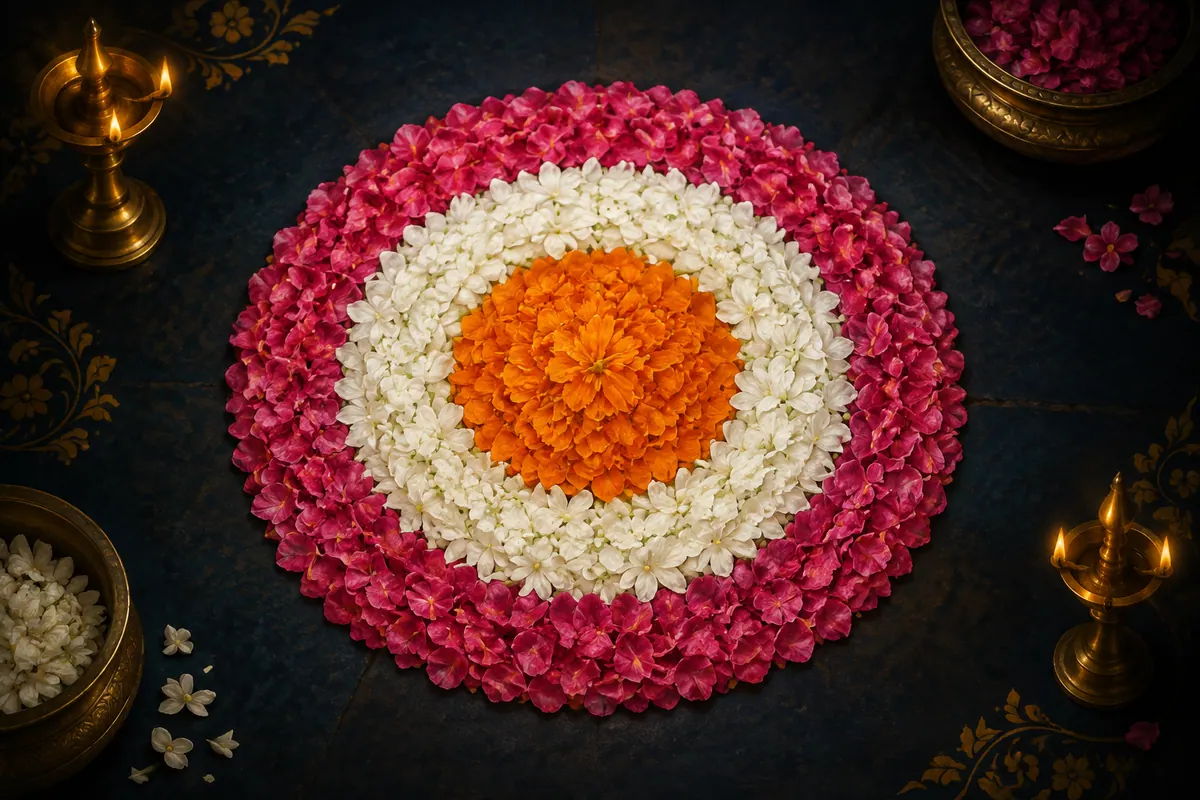
Make a small pookalam from flower petals and wish for family harmony. In Kerala, Onam’s flower carpets welcome the legendary king Mahabali back to his people.
Blessings
Put a pile of petals in the middle of a table and invite someone to make a pattern with you. A pookalam is a flower carpet made for Onam in Kerala. You can make a little version on a tray with the same idea of welcome. Let each person pick a colour and decide together which one goes in the middle. Then take turns adding small handfuls of petals, with time to ask how everyone has been. The design does not need to cover the whole surface; one or two bands give you enough space to see what each person chose. Set it near where you will share food or greet guests.
How to invite good fortune
- Choose a flat tray or plate and collect a few colours of loose petals. Put each colour into a separate little pile so you can see what you have.
- Set one flower or one patch of petals in the middle. Work outwards, arranging a narrow ring around the centre. Let each person choose where to begin.
- Add another ring in a different colour. As you put the petals down, name something good you would like to share as a family this season.
- Move the tray somewhere people can see it. After the gathering, take a photograph if you want to remember which colours each person chose.
Origins and history
During Onam, flower carpets are laid on the ground to welcome King Mahabali in the story of his yearly homecoming. The festival falls in the Malayalam month of Chingam, around August or September. Designs can change as the celebration goes on, and local versions differ in their flowers and shapes. A pookalam often has rings of petals, but the tradition has room for other outlines too. The flowers change colour as you move around them or see them in a different light. A tray at home keeps the scale small and lets you see who added which part. The finished pattern is a record of the short time you spent making it together.