| Blessings | Business prosperity and financial good fortune |
|---|---|
| What you need | A decorative lucky kumade rake |
Display a Tori-no-ichi Kumade for Prosperity / 🇯🇵 Japan
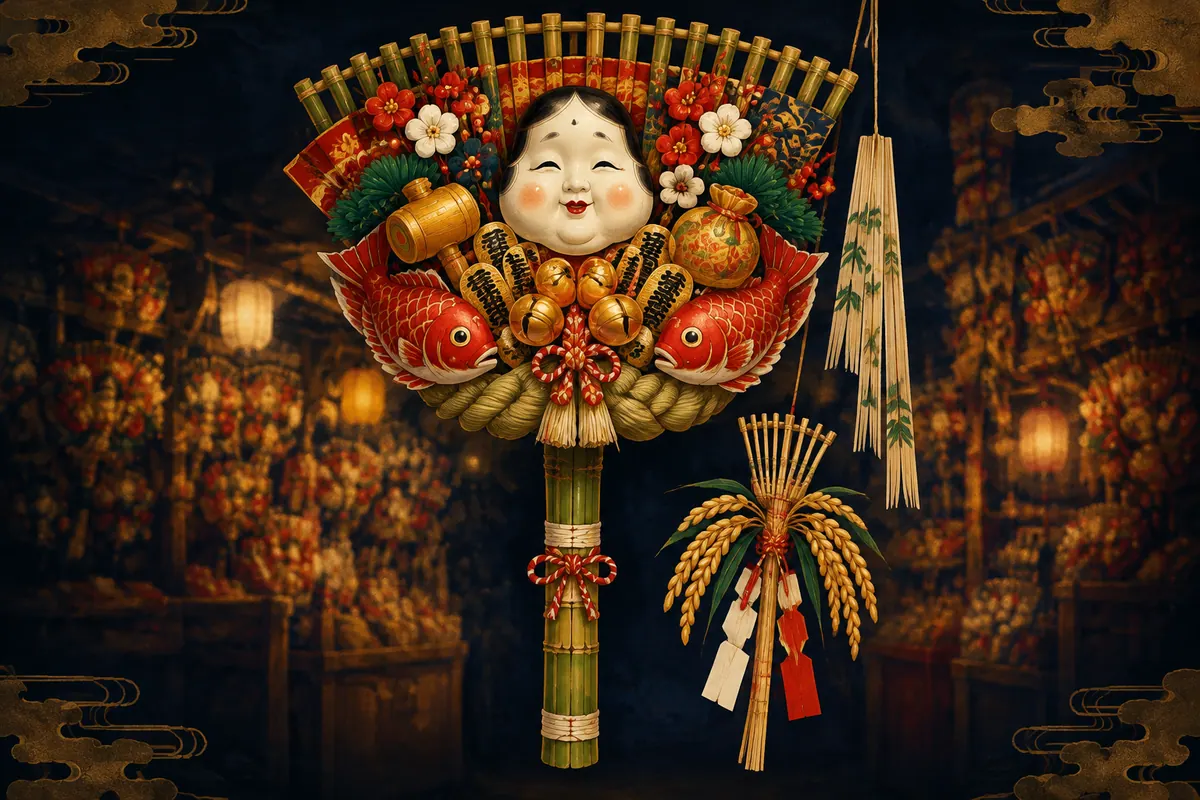
Display a lucky kumade rake at home or work and welcome prosperity. Decorated with coins, smiling faces and other little treasures, this Japanese good-luck object gathers wishes for a flourishing business and financial fortune.
Blessings
A kumade turns the idea of raking things together into a wish to gather good fortune. Its fan of bamboo claws carries ornaments such as coins, rice bales and the smiling face of Okame. Each small treasure gives prosperity a visible form, making the rake a fitting companion for work and new ventures.
There are wall-hanging rakes and freestanding arrangements built into wooden masu boxes. One concrete example is Morito Shoten’s 5-Go Premium Deep Masu Kumade: 35 cm high, 35 cm wide and 25 cm deep, weighing approximately 740 g. Its three-dimensional arrangement brings that festive abundance onto a shelf.
How to invite good fortune
- Choose a decorative kumade with your wish for prosperity in mind.
- Display it on a household altar or in a clean, elevated place where its ornaments face the room. For rakes from Asakusa’s Otori Shrine, south or east is the recommended direction.
- Give thanks for your work and wish for the fruits still to come.
When renewing a previous year’s rake, returning the old one to the temple or shrine where it was received is part of the custom. A freestanding version lets you enjoy the craftsperson’s arrangement as a complete display.
Find products
Affiliate links — we may earn a commission when you buy through these links.
Origins and history
The rake’s claws have been compared with an eagle’s firm grasp. Combined with the tool’s ability to draw things together, that image became a wish to gather prosperity. Coins, rice bales and cheerful faces turned the rake into a miniature collection of hoped-for blessings.
Held on November’s Days of the Rooster, Tori-no-ichi has been part of the year-end scene since the Edo period. Asakusa’s shrine also tells a story of a legendary hero hanging a rake on a pine in thanks for victory. Lively hand-clapping accompanies the fair, while makers’ displays carry its festive energy into homes. New forms, including box-based ornaments, continue that craft tradition in everyday spaces.